Table of Contents
- Essential Skincare Steps for Beginners: What You Actually Need
- How to Identify Your Skin Type Before You Start
- The 3-Step Minimalist Skincare Routine Framework
- How to Transition to a Minimalist Routine Without Wasting Money
- Budget-Conscious Minimalist Skincare: Better Products, Fewer Steps
- Minimalism for Specific Skin Concerns: Sensitive, Dry, and Acne-Prone Skin
- Conclusion: Your Simpler Routine Starts Today
- Frequently Asked Questions
Last Updated: September 22, 2026
Essential Skincare Steps for Beginners: What You Actually Need
Most beginners start with ten products and end up with irritated skin. The fix is simpler than you think. Learning how to build a minimalist skincare routine means stripping your shelf down to three or four products that actually work together.
A minimalist skincare routine is a short daily regimen built around cleansing, moisturizing, and sun protection, with one treatment product added only if your skin needs it. That's the whole framework.
Here's what you actually need to start:
- A gentle cleanser suited to your skin type
- A moisturizer that supports your skin barrier
- A broad-spectrum sunscreen for daytime
- One optional serum for a specific concern
Everything else is a bonus, not a basic. The American Academy of Dermatology's skincare guidance makes the same point: consistency with a few products beats occasional use of many.
How to Identify Your Skin Type Before You Start
You can find your skin type in one evening with no tools. Wash your face, wait one hour without applying anything, then press a tissue to your forehead, nose, cheeks, and chin.
Here's how to read the results:
- Oily: shine everywhere, tissue sticks to most areas
- Dry: tight, flaky, or rough feeling, no shine
- Combination: shine on the forehead and nose only
- Normal: comfortable, balanced, no strong shine or tightness
- Sensitive: redness, stinging, or reactions to new products
Sensitive skin is a reaction pattern, not an oil level, so you can be both dry and sensitive. If that sounds like you, patch testing matters more than picking the "right" product. Apply a small amount behind your ear or on your inner arm and wait 24 hours before using it on your face. The National Eczema Association's guidance on irritants explains why fragrance and harsh soaps trigger reactions for many people.

Knowing your type tells you which three products to buy. Guessing wastes money.
The 3-Step Minimalist Skincare Routine Framework
The core routine is cleanse, treat, and protect in the morning, and cleanse, treat, and moisturize at night. That's it. Everything else is optional.
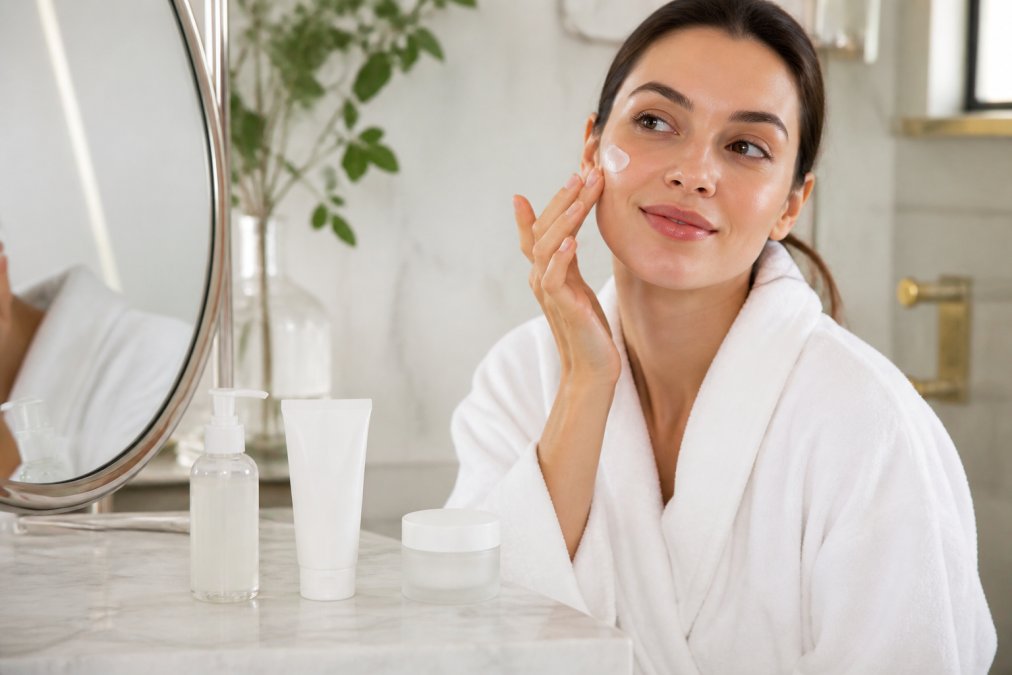
Morning:
- Rinse or cleanse with lukewarm water and a gentle cleanser
- Apply a hydrating serum or moisturizer
- Finish with broad-spectrum sunscreen, SPF 30 or higher
Evening:
- Cleanse to remove sunscreen, oil, and makeup
- Apply your treatment product, such as a retinoid or serum
- Seal in hydration with a moisturizer
A few rules keep this working:
- Keep water lukewarm, since hot water strips your skin barrier
- Apply products thinnest to thickest
- Give each product a minute to absorb before the next
That's the framework. Two products in the morning, three at night, and you're done.
How to Transition to a Minimalist Routine Without Wasting Money
Most guides tell you to throw out half your shelf. Few tell you what happens to your skin, and your head, in the two to six weeks after you do. That transition is where minimalist routines succeed or fail, and it's the part almost no competitor addresses.
Why the first two weeks feel worse, not better
When you stop layering exfoliants, retinoids, and vitamin C daily, your skin often goes through a rebound period. A common pattern is:
- Days 1-3: skin feels calmer, sometimes slightly dull because it's missing the immediate glow from acids or vitamin C
- Days 4-14: breakouts or flaking can appear as skin adjusts to a slower cell-turnover pace, this is not 'purging' in the clinical sense, it's your barrier recalibrating
- Weeks 3-6: most people report more stable tone, less redness, and fewer random reactions
If you quit a 10-step routine cold turkey and your skin flares, the flare is usually the routine leaving, not the new one arriving. Knowing that in advance is what stops you from panic-buying replacements.
A four-week step-down plan
Instead of subtracting everything at once, taper:
Anti-Aging Skincare Routine Essentials →
- Week 1, Stop the duplicates. If you own two serums, two moisturizers, or two sunscreens, pick one of each and shelve the rest. Don't add anything.
- Week 2, Cut the daily exfoliant. Move any acid, scrub, or exfoliating toner to twice a week. Keep your retinoid on its normal schedule if you use one.
- Week 3, Reduce actives to one. Choose the single active that targets your main concern (retinoid for texture and aging, niacinamide or salicylic acid for breakouts, vitamin C for tone) and pause the others.
- Week 4, Lock the core three. Cleanser, moisturizer, sunscreen. Add your one active back only if your skin has been calm for at least seven days.
What to do with the products you're not using
Don't throw away unopened, unexpired products, that's the opposite of minimalist. Options:
- Finish one before opening the next. Rotate rather than replace.
- Repurpose. A gentle hydrating serum you no longer need on your face can go on your neck, chest, or hands.
- Donate unopened items to a local women's shelter or community fridge that accepts personal care, many do, but call first.
- Recycle empties through a brand's take-back program or a store that accepts beauty packaging.
The mental side nobody warns you about
Beauty burnout is real. If your routine became a source of anxiety, checking for reactions, researching new launches, feeling guilty about skipped steps, simplifying will feel uncomfortable before it feels freeing. A useful rule: for the first month, do not buy anything new unless a core product runs out. Give your skin and your habits time to settle before you judge the results.
Here's a simple way to decide what stays:
| Product Type | Keep It If... | Cut It If... |
|---|---|---|
| Cleanser | It leaves skin comfortable | Skin feels tight after |
| Moisturizer | It absorbs without greasiness | It pills under sunscreen |
| Sunscreen | You'll wear it daily | It's expired or you skip it |
| Serum | It targets one clear concern | You can't name its purpose |
| Exfoliant | Used 1-2 times weekly | Used daily or causes redness |
Budget-Conscious Minimalist Skincare: Better Products, Fewer Steps
Spending less on skincare is about buying fewer, better items, not hunting for the cheapest ones. A three-product routine that costs a bit more per item often costs less per month than a ten-product routine you replace constantly.
Ways to save without cutting corners:
- Buy kits instead of single items, since bundles usually cost less than the sum of their parts
- Skip products that duplicate a step you already cover
- Replace products only when they run out, not when a trend appears
- Choose multi-purpose items, like a moisturizer with antioxidants built in
Minimalism for Specific Skin Concerns: Sensitive, Dry, and Acne-Prone Skin
A minimalist routine isn't one routine, it's the same three-step skeleton with one variable swapped: the treatment step. Here's how that plays out for the three concerns readers ask about most, including the mechanism behind each adjustment.
Sensitive skin
What to do:
- Choose fragrance-free over 'unscented', unscented products can still contain masking fragrance
- Look for ceramides, squalane, glycerin, and colloidal oatmeal
- Skip essential oils (lavender, citrus, peppermint) even when they're marketed as calming
- Patch test on your inner arm for 24 hours before anything touches your face

- For dryness: richer creams with ceramides, shea butter, or squalane
- For dehydration: humectants like hyaluronic acid or glycerin, applied to damp skin, then sealed with a moisturizer
Acne-prone skin
Keep it to:
- A gentle, non-comedogenic cleanser (no scrubbing beads, no sulfates)
- A non-comedogenic moisturizer, yes, acne-prone skin still needs one
- One targeted treatment: benzoyl peroxide for inflammatory spots, salicylic acid for blackheads and clogged pores, or adapalene for both
- Broad-spectrum SPF, because many acne treatments increase sun sensitivity
Mature skin
Conclusion: Your Simpler Routine Starts Today
The hard part of skincare isn't finding more products. It's trusting that fewer, better ones will do the job. Start with three steps, match them to your skin type, and add only what your skin asks for.
Frequently Asked Questions
What are the essential steps for a minimalist skincare routine?
A minimalist skincare routine has three core steps: cleanse, moisturize, and protect with broad-spectrum sunscreen. For beginners, start with a gentle cleanser, a moisturizer suited to your skin type, and an SPF 30 or higher. This covers the essentials without overwhelming your skin barrier or your budget. You can add a targeted serum later if needed.
How long does it take to see results from a simplified skincare routine?
Most people notice improvements in hydration and skin texture within two to four weeks of consistent use. However, the skin barrier takes about 28 days to fully renew, so give your minimalist routine at least a month before judging results. If you have specific concerns like acne or fine lines, allow eight to twelve weeks and track changes with photos.
Can a minimalist routine help with anti-aging?
Yes, a minimalist routine can support anti-aging by focusing on the essentials: sun protection, hydration, and gentle exfoliation. Broad-spectrum sunscreen is the most effective anti-aging step, as it prevents UV damage that accelerates fine lines. A serum with antioxidants or retinoids can be added later if you want targeted support without a complex regimen.
Do dermatologists recommend minimalist skincare?
Many dermatologists recommend a minimalist approach, especially for sensitive or acne-prone skin. Fewer products mean less risk of irritation and a stronger skin barrier. Dermatologist-recommended basics include a gentle cleanser, a non-comedogenic moisturizer, and broad-spectrum sunscreen. If you have specific concerns, consult a dermatologist before adding active ingredients.