Table of Contents
- Why Daily Style Efficiency Matters for Busy Professionals
- What You'll Need Before You Start
- Step 1: Run a Wardrobe Audit and Build Your Capsule Wardrobe Essentials for Work
- Step 2: Learn How to Style Casual Wear for Work Without Overthinking It
- Step 3: Master Fit, Proportions, and Tailoring
- Step 4: Use Color Coordination and Monochrome Dressing
- Step 5: Apply Morning Routine Fashion Hacks That Save Real Time
- Common Mistakes That Kill Daily Style Efficiency
- Frequently Asked Questions
Last Updated: September 16, 2026
Why Daily Style Efficiency Matters for Busy Professionals
Daily style efficiency is the practice of reducing the time, money, and mental energy you spend deciding what to wear, while still looking polished and intentional. It replaces guesswork with a repeatable system: a curated closet, a handful of outfit formulas, and a morning routine that runs on autopilot, the difference between leaving the house calm and leaving it frazzled.
The cost of getting dressed badly isn't just aesthetic. A common frustration among working women is the "closet full of nothing to wear" problem: dozens of garments, no clear combinations, and ten minutes lost every morning to indecision. This guide from Sak's Gl'amour breaks down a seven-step approach to fixing that.
Below, we'll walk through each step in order, with the mistakes that derail most people and the shortcuts that hold up on a Tuesday at 7 a.m.
What You'll Need Before You Start
The best time to build a style system is on a quiet evening, not at 7 a.m. with one shoe on. Set aside 90 minutes, clear a bed or floor space, and gather a few tools first.
What you'll need:
- A full-length mirror and good lighting
- A phone for photos (you'll want visual records of outfits that work)
- Two large bags or bins: one for "repair/clean," one for "donate/sell"
- A notebook or notes app for your outfit formulas
- Your calendar, so you can see what your week actually demands
Total time: 90 minutes for the first audit, then 10-15 minutes weekly to maintain it.
One note before you begin: this is not a purge. The goal is information, learning what you reach for and what you avoid. That data makes the rest of the system work.
Step 1: Run a Wardrobe Audit and Build Your Capsule Wardrobe Essentials for Work
A wardrobe audit is a structured review of everything you own, sorted by how often you actually wear it. It's the foundation of capsule wardrobe essentials for work: you can't build a small, functional core until you know what's already in the closet.
Here's how to run it:
- Pull everything out. Every garment, every shoe, every accessory.
- Sort into three piles: wears weekly, wears occasionally, hasn't been worn in a year.
- Try on anything you're unsure about. If it doesn't fit well right now, it goes in the repair or donate bin.
- Photograph the outfits that work. These become your reference library.
- Note the gaps. If you have five blazers and no neutral base layer, that's your first purchase.
Most wardrobes split into a small core of favorites and a large tail of rarely-worn items. That tail creates the illusion of choice without the reality of it.
Step 2: Learn How to Style Casual Wear for Work Without Overthinking It
Learning how to style casual wear for work comes down to one principle: build from a neutral base, then add structure. A fitted tank or tee under a blazer, cardigan, or overshirt reads as intentional in almost any workplace.
The formula is simple:
- Base layer: a clean, fitted tank or tee in white, black, or ivory
- Structure: a blazer, cardigan, or overshirt
- Bottom: tailored trousers, dark denim, or a midi skirt
- Shoes: one pair that works with everything in the rotation
The Classic White Cap Sleeve Tank is built for exactly this role: a fitted, mid-stretch knit with wider straps for coverage and a clean round neckline that sits smoothly under a button-down or cardigan.

Step 3: Master Fit, Proportions, and Tailoring
Fit is the single highest-return style investment you can make, and it costs less than most people assume. A $30 garment that fits properly outperforms a $300 garment that doesn't.
The three fit checks:
- Shoulders: the seam should sit at the edge of your shoulder, not past it
- Length: tops should end at the hip bone or just below; if they're longer, tuck or half-tuck
- Proportions: if the top is oversized, the bottom should be fitted, and vice versa
Step 4: Use Color Coordination and Monochrome Dressing
Color coordination is the fastest way to look put-together without effort, because the eye reads a coherent palette as intentional. Monochrome dressing goes further: one color head to toe in varying shades creates a vertical line that reads as taller, slimmer, and more deliberate.
Three palettes that work for almost everyone:
- Neutral core: white, black, ivory, camel, gray
- Soft contrast: navy with cream, charcoal with blush, olive with tan
- Monochrome: three shades of the same family, like ivory, cream, and oatmeal
Step 5: Apply Morning Routine Fashion Hacks That Save Real Time
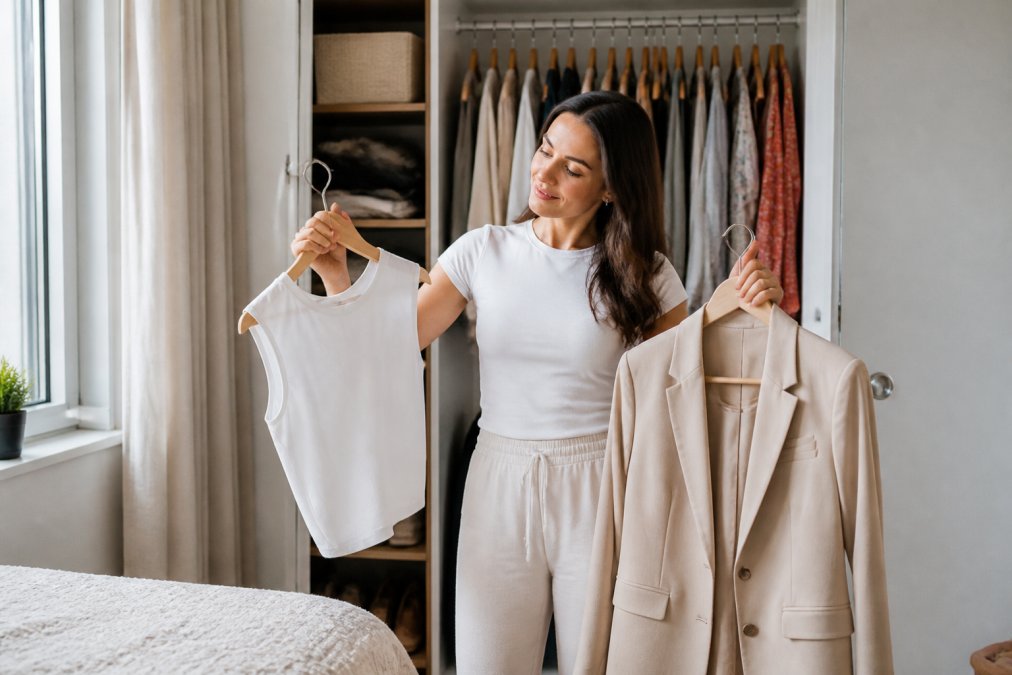
Most morning-routine advice fails because it treats dressing as a willpower problem. It isn't. It's a decision-volume problem, and the fix is to move decisions out of the morning entirely, into a batch you do once a week, not once a night.
Common Mistakes That Kill Daily Style Efficiency
The biggest mistake is treating style efficiency as a shopping problem. Buying more clothes to fix a closet that already has too many just adds noise; the fix is subtraction and structure first, additions second. But the mistakes that quietly cost the most live in your bank account and your laundry basket, not your closet.
Mistake 6 (the other gap): Letting laundry cycles dictate your wardrobe. A surprising amount of morning friction comes from clothes that are clean but not ready, wrinkled, missing a button, still damp. Efficiency isn't just picking outfits; it's the care cycle behind them. Three habits fix most of it:
- Wash less, air more. Most knits and structured pieces don't need a full wash after one wear. Airing them overnight on a hook extends wear cycles and cuts laundry volume significantly.
- Fix on sight. Keep a small sewing kit and a lint roller where you dress. Repairing a loose button the moment you notice it prevents the piece from disappearing into the "needs fixing" pile for six months.
- One-in, one-out rotation. When a piece comes out of the wash, it goes straight back to its assigned spot in the front-of-closet rotation. No pile, no friction.
| Mistake | What It Costs You | The Fix |
|---|---|---|
| Buying trends before a base | Money on items that don't combine | Build 10-15 neutral core pieces first |
| Ignoring fit for brand | Garments that sit unworn | Budget for tailoring, not labels |
| Keeping "someday" clothes | Clutter and decision friction | Donate anything unworn for a year |
| No outfit formulas | Morning indecision | Write down 5 combinations that work |
| Ignoring cost-per-wear | Overspending on low-wear pieces | Ask "will I wear this 10+ times?" |
| Letting laundry dictate the closet | Wrinkled, unavailable pieces | Wash less, fix on sight, one-in-one-out |
Frequently Asked Questions
What is the 3-3-3 rule for outfits?
The 3-3-3 rule keeps your outfit to three colors, three textures, and three accessories. Limiting colors to three stops you second-guessing combinations in the morning. Three textures, like a soft knit tank under a structured blazer with denim, add visual interest without clutter. Three accessories, such as earrings, a belt, and a bag, finish the look. The rule works because it gives you a clear stopping point, which is exactly what daily style efficiency needs when you are short on time.
How can I build a capsule wardrobe for work without spending a fortune?
Start with a wardrobe audit: pull out everything you wore in the last month and set the rest aside. Build around neutral base layers you can layer and rewear, like a Classic White Cap Sleeve Tank at $29 or a Classic Black Cap Sleeve Tank at $29 from Sak's Gl'amour. Add two pairs of well-fitting trousers, one blazer, and two pairs of shoes. Aim for pieces that mix with at least three other items. This approach keeps costs down because every purchase earns its place instead of sitting unworn.
How do I simplify my morning routine to save time on styling?
Plan outfits the night before and hang them in one place so there is no decision-making at 7 a.m. Group your closet by category so tops, bottoms, and layers are easy to scan. Stick to a color palette of two or three neutrals plus one accent. Keep a go-to outfit formula, such as a fitted tank, tailored trousers, and a blazer, for days when you are rushed. These morning routine fashion hacks cut styling time because you remove choices, not because you rush.
What is the 60-30-10 rule in fashion?
The 60-30-10 rule splits your outfit into three color proportions: 60 percent dominant color, 30 percent secondary color, and 10 percent accent. For example, wear a black blazer and black trousers (60 percent), a white tank underneath (30 percent), and a gold necklace or patterned scarf (10 percent). This structure makes any combination look intentional and balanced. Once you apply it a few times, you stop second-guessing whether colors work together, which speeds up getting dressed.
Building a style system takes one focused evening and a few honest decisions, but the payoff compounds every single morning. Sak's Gl'amour curates the neutral base layers that make the whole system work, from fitted cap sleeve tanks in white, black, and ivory to relaxed essential tees designed for easy layering. Explore the collection and build a closet where every piece earns its place.