Table of Contents
- How to Select High Quality Apparel: The 7-Point Checklist
- How to Check Fabric Quality in the Store
- High-Quality Clothing Materials: What to Look For on the Label
- Clothing Construction Quality: Seams, Stitching, and Hardware
- How to Spot Quality Clothing: Fit, Sizing, and Alteration Potential
- Care Requirements and Cost Per Wear
- Quality Basics from Sak's Gl'amour
- Frequently Asked Questions
Last Updated: October 12, 2026
How to Select High Quality Apparel: The 7-Point Checklist
High quality apparel is clothing built from durable fabric, strong stitching, and hardware that survives real wear. It looks better after ten washes, not worse.
The difference between a piece that lasts five years and one that pills by month two comes down to a handful of checks most shoppers never make.
Below, we'll show you exactly how to select high quality apparel using seven checks you can run in any fitting room in under five minutes.
But first, here's what most guides get wrong: they treat price as a proxy for quality. The US Federal Trade Commission's textile and wool labeling rules require accurate fiber content on labels, which gives you a legal starting point most shoppers ignore.
Here's the checklist before we break down each point:
| # | Check | What You're Looking For | Time |
|---|---|---|---|
| 1 | Fabric content | Natural fibers or smart blends | 30 sec |
| 2 | Fabric weight | Substantial, not see-through | 20 sec |
| 3 | Stretch and recovery | Snaps back into shape | 15 sec |
| 4 | Seams and stitching | Dense, even, no loose threads | 60 sec |
| 5 | Hardware | Smooth zippers, secure buttons | 30 sec |
| 6 | Pattern alignment | Matches at the seams | 30 sec |
| 7 | Fit and alteration room | Fits now or can be fixed | 60 sec |
How to Check Fabric Quality in the Store
Fabric quality drives how long a garment lasts. Two tests tell you most of what you need in under a minute.
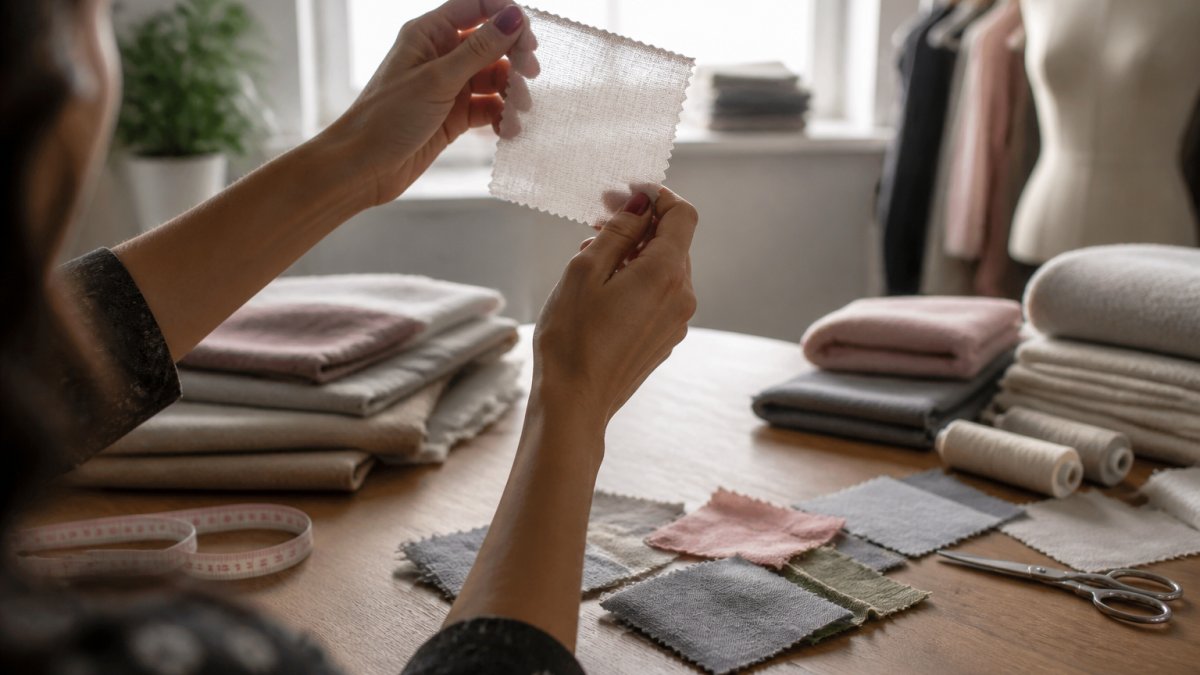
The light test. Hold the fabric up to a window or overhead light.
The stretch test. Grip the fabric with both hands, pull gently, then let go. Good fabric springs back; poor fabric stays stretched out, and that baggy look is permanent.
A few more things to check while you're holding it:
- Rub the fabric between your fingers. Does it feel dense or papery?
- Scrunch it in your fist, then release. Wrinkles that stay sharp are a bad sign for everyday wear.
- Check the underarm and inner thigh areas on dark garments. Shine there means the fibers are already breaking down.
High-Quality Clothing Materials: What to Look For on the Label
The fiber label is the most honest document in the store. It tells you what you're actually buying, and it's required by law in most markets.
Natural fibers, synthetic fibers, and blends
Natural fibers, cotton, wool, linen, silk, leather, breathe, age well, and feel better against skin. Synthetic fibers like polyester and nylon add stretch, strength, and wrinkle resistance.
Read the percentages, not just the fiber names:
- 100% cotton or wool: excellent, if the fabric weight is right
- 95% cotton / 5% elastane: good stretch without losing the natural feel
- 50% polyester / 50% cotton: durable but warmer and more prone to pilling
Our Ring-Spun Cotton T-Shirt 31USA is a good example of a label worth reading: 100% ring-spun combed cotton, preshrunk, about 4.5 oz. Ring-spun yarn is smoother and stronger than standard cotton, which is why it holds up better over time.

Fabric weight, thickness, and opacity
Fabric weight is measured in ounces per square yard or grams per square meter. Heavier fabric generally lasts longer and drapes better, but heavier isn't always better for every garment.
Here's a rough guide:
- Lightweight (under 5 oz): summer shirts, delicate tops
- Midweight (5-7 oz): everyday tees, most casual wear
- Heavyweight (7 oz and up): workwear, structured pieces, long-lasting basics
If you want a tee that survives years of washing, look for something like our Ironside The Heavy One 1601, roughly 7 oz and garment dyed to resist shrinkage, that weight is why it keeps its shape.

Textile Exchange's materials and fiber market guidance is worth reading if you want to understand how fiber choices affect both durability and environmental impact.
Clothing Construction Quality: Seams, Stitching, and Hardware
Construction is where cheap clothing gives itself away. Turn the garment inside out: the outside can be pressed to look premium, but the inside tells the truth.
Objective construction checks you can run in the fitting room
These checks separate workmanship from marketing, and none require tools.
Seam allowance and finishing. Seam allowance is the extra fabric folded inside the seam.
Stitch density. More stitches per inch means a stronger seam.
Stitch type at stress points. Underarms, crotch, pocket corners, and the top of a side slit take the most strain.
Hem and edge finishing. A quality hem is turned up evenly and stitched with a blind or cover stitch that doesn't show outside.
A quick in-store construction checklist
Run these in order, inside out, in under two minutes:
Ring-Spun Cotton T-Shirt 31USA →
- Turn the garment inside out and look at the main side seam. Is the seam allowance finished or raw?
- Count stitches over one inch on the side seam. Aim for roughly 10-12 per inch.
- Check the underarm, crotch, and pocket corners for bar tacks or double stitching.
- Look at the hem depth, is it even all the way around?
- Zip the zipper fully up and down. Does it catch or skip?
- Tug each button gently. Does it feel secure?
- On a lined garment, check that the lining has room to move and isn't pulling.
Pattern alignment, prints, and dye quality
Stripes, plaids, and prints should line up across the seams. If the pattern jumps at the side seam or shoulder, the maker cut corners to save fabric.
For solid colors, rub a white cloth or tissue against the fabric, if color transfers, the dye will bleed in the wash and fade fast. Check that color is even across the whole garment; a mismatch between body, sleeves, and collar means the pieces were dyed in different lots.
How to Spot Quality Clothing: Fit, Sizing, and Alteration Potential
Good fit matters as much as good construction, a well-made garment that doesn't fit you is still a bad purchase. And fit isn't just about the mirror today; it's about whether the garment can be adjusted, and whether that adjustment is worth the cost.
The fit checks that matter most
Start with the shoulders. On a jacket or shirt, the shoulder seam should sit at the edge of your shoulder, not past it. Shoulders are the hardest and most expensive thing to alter, so they must be right from the start, if the seam droops past your shoulder bone, walk away.
Then check the room to move:
- Can you raise your arms without the hem lifting past your waist?
- Does the fabric pull across your chest or back when you reach forward?
- Is there at least a finger's width of ease at the waistband?
For trousers, check the rise (crotch seam to waistband): too short and it pulls, too long and the crotch hangs low. Check the seat too, horizontal pull lines mean too tight; sagging means too loose.
Alteration potential: what can and cannot be fixed
Before you buy, ask: if this doesn't fit perfectly, can a tailor fix it, and is the fix worth the cost?
Easy and inexpensive to alter:
- Hem length on trousers, skirts, and sleeves
- Waist take-in on trousers and skirts (up to about two inches)
- Sleeve length on a shirt or jacket (if the cuff has no functional buttons)
Hard or expensive to alter:
- Shoulders and shoulder width
- Chest or bust size on a lined jacket
- Crotch depth and rise on trousers
A useful rule: if the alteration costs more than about a third of the garment's price, it's usually not worth it unless the garment is otherwise exceptional. If the shoulders and chest fit, a tailor can handle most of the rest.
Sizing, online shopping, and the return policy test
Sizing charts vary between brands, so compare the chart to a garment you already own and love, measure the chest, waist, and length flat, and compare those numbers to the chart, not the size label.
If a brand's return policy is unclear, or returns aren't free, look elsewhere. A generous return policy signals the brand expects its sizing to work for most people, and protects you if the fit is off.
A repeatable fit-and-alteration checklist
Run this in the fitting room or before you order online:
- Shoulder seam sits at the edge of your shoulder, not past it.
- Raise your arms: does the hem lift past your waist?
- Reach forward: does the fabric pull across the chest or back?
- Sit down: does the waistband dig in or gap?
- Check the rise and seat on trousers for pull lines or sagging.
- Ask: if this doesn't fit, can a tailor fix it cheaply?
- Check the return policy before you buy online.
Care Requirements and Cost Per Wear
The price on the tag is not the real cost of a garment, cost per wear is. A budget top worn twice is expensive per wear; a better-made piece worn weekly for years costs pennies each time.
To work it out, divide the price by the number of times you expect to wear it:
- A $20 top worn 3 times = about $6.67 per wear
- A $90 top worn 60 times = $1.50 per wear
Care requirements feed into this: a garment that needs dry cleaning after every wear costs more to own than one you can machine wash cold and tumble dry low. Our Men's Heavyweight Short Sleeve Crew Neck T-Shirt is built for easy care, with a ribbed collar that keeps its shape.

A few care habits that extend any garment's life:
- Wash cold and inside out to protect color and surface
- Skip the dryer for anything with stretch
- Air dry knits flat so they don't stretch on the line
Quality Basics from Sak's Gl'amour
You don't need a lab to judge clothing, just a light source, your hands, and five minutes.
The seven checks in this guide cover fabric, construction, hardware, pattern, fit, and long-term cost. Run them once and thin fabric, loose seams, and cheap hardware become easy to spot.
We build our apparel collection around exactly these standards: pieces that hold their shape, feel good against the skin, and fit into a wardrobe you'll actually wear, real fabric weights, honest labels, and construction that survives the wash cycle.
Frequently Asked Questions
What should I look for in well-made clothing?
Check four things: fabric weight and hand feel, seam density, pattern alignment, and hardware quality. High-quality clothing materials like ring-spun cotton feel substantial and hold shape. Look for at least 10 to 12 stitches per inch on seams, matched patterns at side seams, and metal zippers that glide. These checks reveal clothing construction quality faster than any brand label.
How can I tell if a garment is made to last?
Turn it inside out. Look for seam allowance width, clean finishing, and reinforced stress points. A garment made to last has flat seams with no loose threads, a lining that lies smooth, and buttons sewn with a shank. Fabrics like 100% ring-spun cotton or heavyweight blends resist pilling and shrinkage. These details separate how to spot quality clothing from guesswork.
Which fabrics are best for everyday clothing?
Cotton, wool, linen, and silk remain the most durable natural fibers. For daily wear, ring-spun cotton offers softness and strength, while heavyweight cotton blends resist stretching. Synthetic fibers like polyester add wrinkle resistance but pill over time. A blend of natural and synthetic fibers can balance comfort, durability, and care needs, depending on how you plan to wear the piece.
How should clothing fit when you buy it?
It should fit well in the shoulders and chest, with room to move. Check that seams sit at the natural shoulder edge, sleeves end at the wrist bone, and the hem hits where intended. If a garment is slightly loose in the waist or long in the hem, a tailor can adjust it. Buy for the largest measurement and alter down, not up, for the best result.
Most shoppers waste money on garments that look fine and fall apart fast. Sak's Gl'amour curates apparel built to last, from ring-spun cotton tees to heavyweight basics that resist shrinkage. Our collection focuses on real fabric quality, honest sizing, and pieces that earn their place in your wardrobe. Get started with Sak's Gl'amour and build a closet that holds up year after year.