Table of Contents
- What Makes a Product Worth Curating
- How to Build a Curated Lifestyle Collection
- The Benefits of Shopping at Curated Lifestyle Stores
- Essential Wellness Products for Professionals
- Budget-Conscious vs. Luxury Curation: Finding Your Price Point
- Where to Buy Curated Lifestyle Products Online
- Maintenance and Longevity: Caring for Your Curated Pieces
- Frequently Asked Questions
Last Updated: September 17, 2026
What Makes a Product Worth Curating
Curated lifestyle products are items selected by an editor or buyer against a defined set of standards, rather than stocked because a distributor offers them. At Sak's Gl'amour, our entire catalogue is built on this principle: a smaller range of apparel, skincare and wellness pieces chosen so you don't have to sift through thousands of near-identical options to find the one worth owning.
Walk through a mass-market retailer and count the versions of the same white t-shirt. In a genuinely curated shop, the count drops but the reasoning behind each piece goes up.
Vetting Criteria: How to Spot Real Curation
Real curation follows a documented process; marketing copy is not a process. When deciding where to buy curated lifestyle products, ask what criteria the shop applies, and whether they'll tell you.
A practical vetting checklist:
- Material transparency: Can you see the full fabric or ingredient breakdown, not just "premium blend"?
- Construction detail: Are seams, linings and hardware described specifically?
- Sourcing ethics: Does the brand name how and where items are made?
- Fit guidance: Are sizing charts measured from real garments, with fit notes per style?
- Return terms: Is the policy written plainly, without conditions buried three pages deep?
- Range coherence: Do the products make sense together, or is it a random assortment?
A shop that answers four or more of these clearly is doing real work. One that answers none is reselling with better photography.
How to Build a Curated Lifestyle Collection
Building a curated lifestyle collection starts with deciding what you want your daily life to feel like, then buying only pieces that serve that picture. Most people do it backwards: they shop first and try to construct a style from the results.
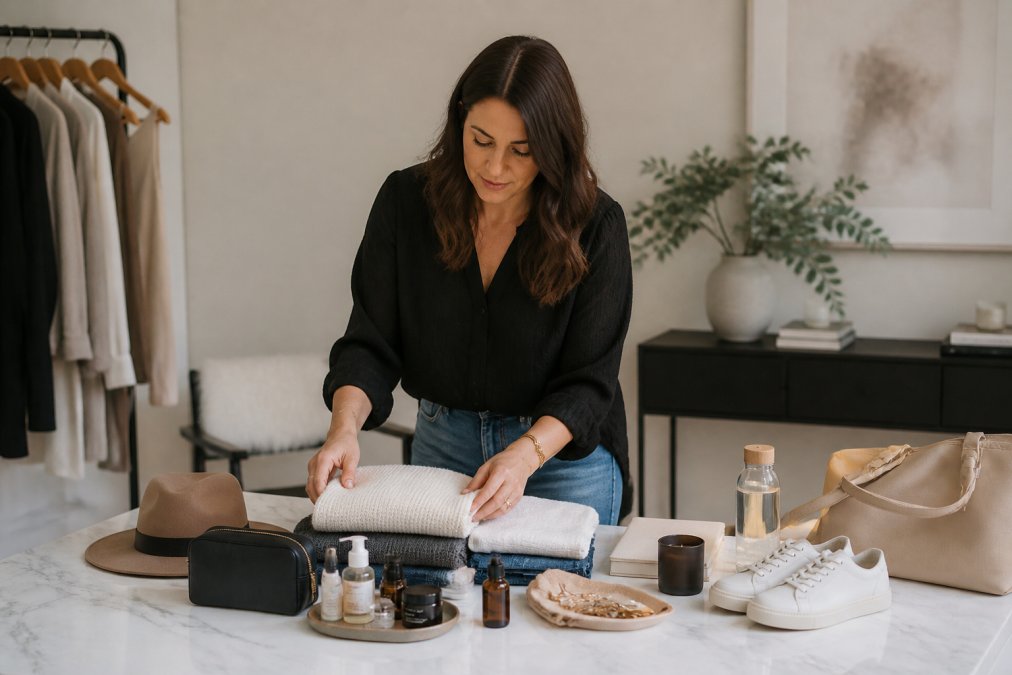
That produces closets full of things that don't combine. Here's the sequence that works.
Start With a Signature Style, Not a Shopping List
Write down three words describing how you want to look and feel on a normal Tuesday, not a wedding. Words like "soft," "structured," "effortless" or "polished" work better than brand names.
The Benefits of Shopping at Curated Lifestyle Stores
The benefits of shopping at curated lifestyle stores come down to time, fit and follow-through. A good curator has already filtered for quality, so your job shifts from research to selection, a structural advantage, not an emotional one.
Three concrete advantages, with the mechanism behind each:
- Less decision fatigue. Comparing forty near-identical options costs more attention than most people realise; shoppers often abandon a purchase because the comparison exhausted them. A curated range of ten to twenty pieces removes that step entirely.
- Better consistency. Pieces chosen against one design philosophy, colour palette, fabric weight, silhouette, work together, so a curated wardrobe produces more outfits per item than a random one.
- Accountability. A shop with a narrow range has reputational skin in the game on every item it carries. If one piece fails, it is a visible percentage of the catalogue, not a rounding error in a 40,000-SKU warehouse.
The Hidden Cost of a Wide Assortment
A large assortment shifts cost from the retailer to you, in three currencies:
- Time: research, comparison and second-guessing before checkout.
- Returns: a higher probability that any single item misses, because no one vetted it against a standard.
- Regret: the slow realisation that a purchase does not combine with anything else you own.
What Curation Does Not Do
Curation is not a guarantee of taste match. A well-curated shop can still be wrong for you if its editorial point of view doesn't align with your three words. The benefit is that every piece is defensible on its own terms, so you can decide quickly whether it belongs in your life.
Women's Bamboo French Terry Zip Hooded →
Essential Wellness Products for Professionals
Essential wellness products for professionals are the ones that survive a busy week: layers you can move in, sleepwear that helps you rest, and skincare you'll use consistently. Busy professionals rarely need more products, they need fewer, better ones that hold up to repeated use and washing.
Budget-Conscious vs. Luxury Curation: Finding Your Price Point
Price point doesn't determine whether curation is good, it determines how much of the range you can access at once:
| Approach | Typical Spend Per Piece | Best For | Trade-Off |
|---|---|---|---|
| Entry-level curation | Under $25 | Testing a new style direction | Fewer construction details |
| Mid-range curation | $45-$80 | Building a working wardrobe | Slower to complete a full set |
| Investment curation | $85+ | Pieces you'll wear for years | Higher upfront cost |
Where to Buy Curated Lifestyle Products Online
The best place to buy curated lifestyle products online is a retailer with a narrow, well-documented range and a clear editorial standard. Sak's Gl'amour fits that description: a focused selection spanning apparel, skincare and wellness, chosen to help you feel and live a glamorous life without wading through endless listings. But "narrow and well-documented" is a claim, not a method, the useful question is how to verify a shop's curation before you spend.
How to Vet an Online Curator Before You Buy
A shop that does real curation can answer these questions on the product page, without a support ticket:
- Who selects the range, and against what standard? Look for a named buyer, editor or design lead, and a stated point of view (palette, fabric philosophy, silhouette).
- Is the full composition listed? "Premium blend" is not a composition. Percentages are.
- Is sizing measured per style? A chart measured from real garments, with fit notes, is the single strongest signal of a curated operation.
- Is the maker or origin named? At minimum, the country or region of manufacture. Ideally, the mill or workshop.
- Is the return policy plain? Findable in under a minute, without conditions buried three pages deep.
- Does the range cohere? Pick three products at random and ask whether they belong to the same world.
Regional and Local vs. Global Curation
Local curation gives you pieces tied to a place: regional makers, seasonal ranges, shorter supply chains. Global curation gives you materials and construction a single region may not produce at scale. Most people benefit from both, but decide per product, not per brand.
A practical way to choose:
- Buy local when the value is in the maker. Small-batch ceramics, leather goods, or textiles where the workshop is the point. You are paying for proximity and provenance.
- Buy global when the value is in the material. Fibres that grow in specific climates, or construction techniques concentrated in a region, are supply-chain decisions rather than corner-cutting.
- Buy either when the documentation is strong. A clearly documented global supply chain beats an undocumented local claim every time.
Maintenance and Longevity: Caring for Your Curated Pieces
Curated pieces last longer when you treat the care label as part of the purchase. Most premature wear comes from washing too hot and drying too hard.
- Wash cold on a standard cycle
- Turn prints and knits inside out before washing
- Skip fabric softener on moisture-wicking fabrics, since it coats the fibres
- Tumble dry low, or air dry flat for knits
- Store folded rather than hung for stretch fabrics
Frequently Asked Questions
What defines a curated lifestyle product?
A curated lifestyle product is selected by a person or team who applies specific criteria: quality craftsmanship, ethical sourcing, timeless design, and fit with a defined aesthetic. It is not simply a bestseller. Curation means someone has already filtered out the noise, so every item earns its place through materials, construction, and purpose rather than marketing budget alone.
How do I choose between mass-market retailers and curated lifestyle shops?
Mass-market retailers prioritize volume and price, which often means thinner fabrics and shorter product lifespans. Curated lifestyle stores prioritize quality craftsmanship and intentional living, so you buy fewer pieces that last longer. If you want unique finds that reflect your personal style instead of whatever is trending, a curated shop saves you the filtering work.
Are curated lifestyle products worth the investment?
When a piece is made from durable materials and designed to last, the cost per wear drops over time. A bamboo viscose hoodie at $62.99 that holds its shape through dozens of washes often costs less per year than three cheaper alternatives that pill or lose fit. The investment pays off when you choose items you will actually wear or use repeatedly.
What should I look for when shopping for lifestyle essentials online?
Check three things: material composition, sizing accuracy, and the store's return policy. Look for specific fabric blends like bamboo viscose or organic cotton rather than vague descriptions. Read sizing charts carefully because curated brands often use precise measurements. A clear return policy removes the risk from buying apparel or wellness items you cannot try in person.